Choosing the right Ball Bearing Cnc Machine requires more than comparing advertised speed, price, or spindle power. Manufacturers differ in bearing geometry, control systems, thermal stability, and after-sales support. A machine may look impressive on paper, yet produce uneven raceways after hours of operation. That detail matters.
This guide examines the Top 10 Ball Bearing CNC Machine Manufacturers Worldwide through practical and technical criteria. These include machining accuracy, spindle runout, repeatability, automation options, energy use, operator safety, and global service capability. We also consider real workshop conditions, such as coolant exposure, vibration near the spindle, and the fine metallic dust that collects around bearing production lines. Manufacturer specifications provide a starting point. Independent certifications, customer experience, and service records provide stronger evidence.
Quality is never created by inspection alone. W. Edwards Deming, a leading authority on manufacturing quality, stated, “Quality comes not from inspection, but from the improvement of the production process.” His principle remains highly relevant to precision bearing production. A reliable supplier should improve processes continuously, not merely repair defects afterward.
No ranking is flawless. Regional support, installation skill, and production volume can change the best choice. Some manufacturers communicate technical limits clearly; others leave important details unexplained. That difference deserves attention. This introduction therefore encourages careful comparison, realistic expectations, and independent verification before investment. The strongest Ball Bearing CNC Machine is not always the fastest. It is the one that delivers stable accuracy, practical maintenance, and dependable results over time.
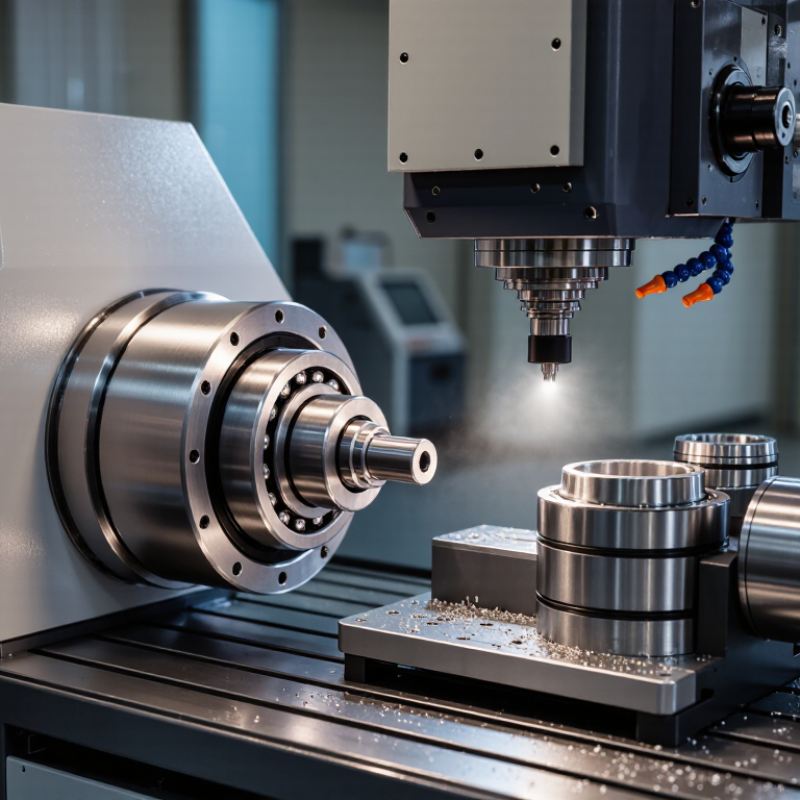
Ball-bearing CNC machines rely on rolling-contact guides or ball screws to convert motor torque into controlled axis movement. Common types include three-axis mills, four-axis indexers, five-axis machining centers, turning centers, and CNC grinders. Three-axis systems suit plates and pockets. Five-axis machines reach angled surfaces with fewer setups, reducing alignment errors.
Axis count alone does not prove precision. ISO 230-2 evaluates positioning accuracy and repeatability along each linear or rotary axis. Tests often use laser interferometers, calibrated scales, and repeated approaches from both directions. The standard helps identify reversal error, pitch deviation, and thermal drift. It does not guarantee cutting accuracy under every production condition.
A 2024 industry outlook from Fortune Business Insights valued the global machine-tool market at more than 80 billion US dollars, with CNC equipment representing a major share. Reports from MarketsandMarkets also project continued CNC adoption through automation and aerospace demand. These figures show growth, not automatic quality. A warm ball screw can expand during a long cycle. That detail is easy to miss.
For procurement, request ISO 230-2 test results for every relevant axis. Compare repeatability at the actual travel length, not only brochure resolution. A machine claiming 0.001-millimeter command resolution may still produce larger errors after thermal loading. My practical preference is simple: inspect the test method, environmental conditions, and maintenance history before trusting a headline specification.
Manufacturers in this ranking are assessed against demanding production realities. A five-axis platform must control rotary motion smoothly, not merely advertise extra axes. Positioning accuracy of ≤0.005 mm is essential for bearing races, housings, and miniature components. However, the figure must come from documented testing, not a brochure claim. Inspection reports, thermal compensation records, and repeatability data matter more.
During evaluation, engineers should examine spindle stability at production speed. They should also check probing accuracy after several hours of operation. Heat changes everything. A machine may meet its specification in a climate-controlled room, then drift beside a busy factory line. That weakness deserves attention. Coolant filtration, vibration control, and automatic calibration can protect tight tolerances. Still, even strong systems require skilled operators and disciplined maintenance.
Global service forms the third ranking pillar. Response time, local technicians, spare-parts access, and remote diagnostics can prevent costly downtime. Ask whether service teams understand bearing production, rather than only general machining. Training quality also reveals practical experience. Some published service promises sound impressive but remain difficult to verify. A reliable supplier provides clear escalation procedures and realistic repair timelines. The final ranking should reward measurable performance, transparent evidence, and support that works beyond the sales contract.
Worldwide manufacturers of bearing turning, grinding, and superfinishing CNCs serve demanding industries such as automotive, aerospace, energy, and precision machinery. Their equipment must produce consistent raceways, rings, rollers, and cages under continuous production pressure. Reliable machines combine rigid structures, high-speed spindles, accurate workholding, and responsive control systems.
Bearing turning CNCs shape rings before heat treatment, where stable cutting reduces uneven stock and protects later grinding operations. Grinding CNCs then control diameter, roundness, waviness, and surface geometry within extremely narrow limits. Superfinishing CNCs remove microscopic peaks from raceways and rollers. This improves contact quality, noise behavior, and lubricant distribution. In practical production, coolant filtration matters as much as spindle power. Dirty fluid can quietly damage surface results.
Experienced manufacturers also support automated loading, in-process gauging, tool compensation, and traceable quality data. These features help operators correct thermal drift before defective batches grow. However, specifications can look better than real factory performance. Buyers should examine cycle-time records, sample parts, maintenance access, and service response in comparable conditions. A polished demonstration is not enough. Ask for measurement evidence.
The strongest suppliers usually understand complete bearing workflows, not isolated machines. They adapt turning allowances, grinding parameters, and superfinishing pressure to material grade and bearing size. Training is equally important. Even advanced equipment depends on careful setup and disciplined inspection. Some selection decisions remain uncertain until trials begin, especially with thin rings or difficult materials. That is where honest testing reveals both capability and limitations.
High-speed CNC manufacturers are often compared by spindle speed, but 20,000 RPM alone proves little. A reliable spindle needs stable thermal control, precise balancing, and consistent bearing preload. ISO P4 bearings support tighter accuracy than standard classes, especially during continuous cutting. However, the machine structure must match that precision. Small errors compound.
When reviewing leading manufacturers, examine spindle runout, acceleration time, cooling design, and measured performance under load. A spindle reaching 20,000 RPM may lose accuracy after several hours of operation. Ask for test data at operating temperature, not only factory specifications. Automation also changes the comparison. Pallet changers, tool monitoring, and robotic loading can reduce idle time, but poor integration creates delays. I have seen efficient hardware perform badly because sensors were positioned poorly.
Tips: Check runout at the tool holder, not only at the spindle nose. Confirm whether ISO P4 bearings are matched, preloaded, and replaceable. Request noise and vibration readings at several speeds. Review maintenance access before purchase. A catalog claim is not proof. Evaluate service response, software compatibility, and operator training. Even strong machines need adjustment; that part is sometimes underestimated.
Selecting a CNC machine manufacturer requires more than comparing spindle speed. In aerospace workshops, bearing accuracy affects surface finish, thermal stability, and repeatable hole locations. Automotive plants usually prioritize cycle time, automated loading, and dependable operation across long shifts. Medical component makers often need cleaner processes and tighter vibration control.
ISO 281 life ratings provide a useful starting point. They estimate bearing fatigue life under defined loads and operating conditions. However, the rating is not a promise. Coolant contamination, incorrect preload, poor lubrication, and sudden acceleration can shorten real service life. Ask manufacturers for load calculations, testing conditions, and maintenance records. A rating without assumptions is incomplete.
Purchase cost should include installation, replacement bearings, energy use, inspection time, and lost production. Throughput also needs careful measurement. A machine producing 200 parts daily may still perform poorly if setup takes two hours. Request sample cycle data from parts similar to yours. I once treated catalog throughput as production output. That was a mistake. Actual results changed after tool changes, operator checks, and chip removal were included. Compare ten leading manufacturers using the same material, tolerance, batch size, and acceptance criteria. Small details decide large investments.
JK Machinery a.s.
Psohlavců 322/4, Praha 4,
Czechia
T: +420 777 610 380
E: sale@roll-formingmachinery.com